
Training for Life, Pt. I: How Functional Movement Protects Your Longevity
A Tale of Two Trajectories
A few years ago, I witnessed a striking contrast in aging.
My dad moved into a senior living community in his late nineties and found himself surrounded by neighbors navigating varying degrees of physical limitation that hindered their daily routines. Yet he remained fully independent, carrying himself with a quiet, steady poise. He went on to live to 101, maintaining his physical sovereignty almost until his very last days.
When people asked for his secret, he always pointed back to his youth. He was a state champion gymnast back in the 1930s. But I believe his longevity wasn't a lingering gift from a medal won decades earlier. It was something far more subtle and accessible.
He was a man of moderation who simply never lost his identity of movement. In his mind, he wasn't an aging physique waiting for decline; he was a person whose physical body was designed to balance, control itself in space, and respond when called upon. His daily choices naturally reflected that belief.
The stark difference between his reality and the reality of so many around him wasn't a matter of luck or genetic privilege – his parents died in their 40s and 50s. It was a tale of two different trajectories. One was built on a lifelong practice of functional capability and the other was shaped by the slow, modern drift toward physical passivity.
Which brings us to the core question of your next life chapter: How do you cultivate an enduring identity of movement today, so that your future self retains its independence?
World-Class Fitness Demystified
To build an enduring identity of movement, we first have to strip away the noise around what exercise is supposed to look like. We aren't training for aesthetics, and we aren't training to excel at a single machine in a gym. We’re training for life.
In the CrossFit philosophy, fitness is summarized in a famous 100-word definition with this underlying principle: True physical capability is general, broad, and inclusive.
Stripped down to its essence, training for longevity includes:
Move your body in natural, varied ways: Movements should include lifting, pulling, bending, reaching, and balancing.
Focus on real-world utility: Emphasize compound movements over isolated muscles on gym machines.
Keep your routine engaging and adaptable: Train your body for whatever events and experiences your future holds.
The goal isn't to specialize in one type of activity. It’s to care for your physical body so it continues to support your freedom.
The Art of Scaling: From the Olympic Podium to Your Daily Life
When people read fitness terms like deadlifts, squats or overhead presses, it’s easy to feel intimidated or assume those movements belong exclusively to elite athletes.
But one of the most empowering principles of functional movement is this: Our physical needs differ by degree, not by kind.
The movement patterns of an Olympic athlete and someone stepping into their 60s, 70s and beyond are fundamentally identical:
The Squat: Sitting down and standing up safely from a chair, the couch, or the floor.
The Deadlift: Picking up a bag of groceries, a basket of laundry, or a suitcase off the floor without hurting your back.
The Press: Reaching up to place a box onto a high shelf.
Balance: Navigating uneven pavement, trail rocks, or steps with confidence.
The difference lies entirely in scale.
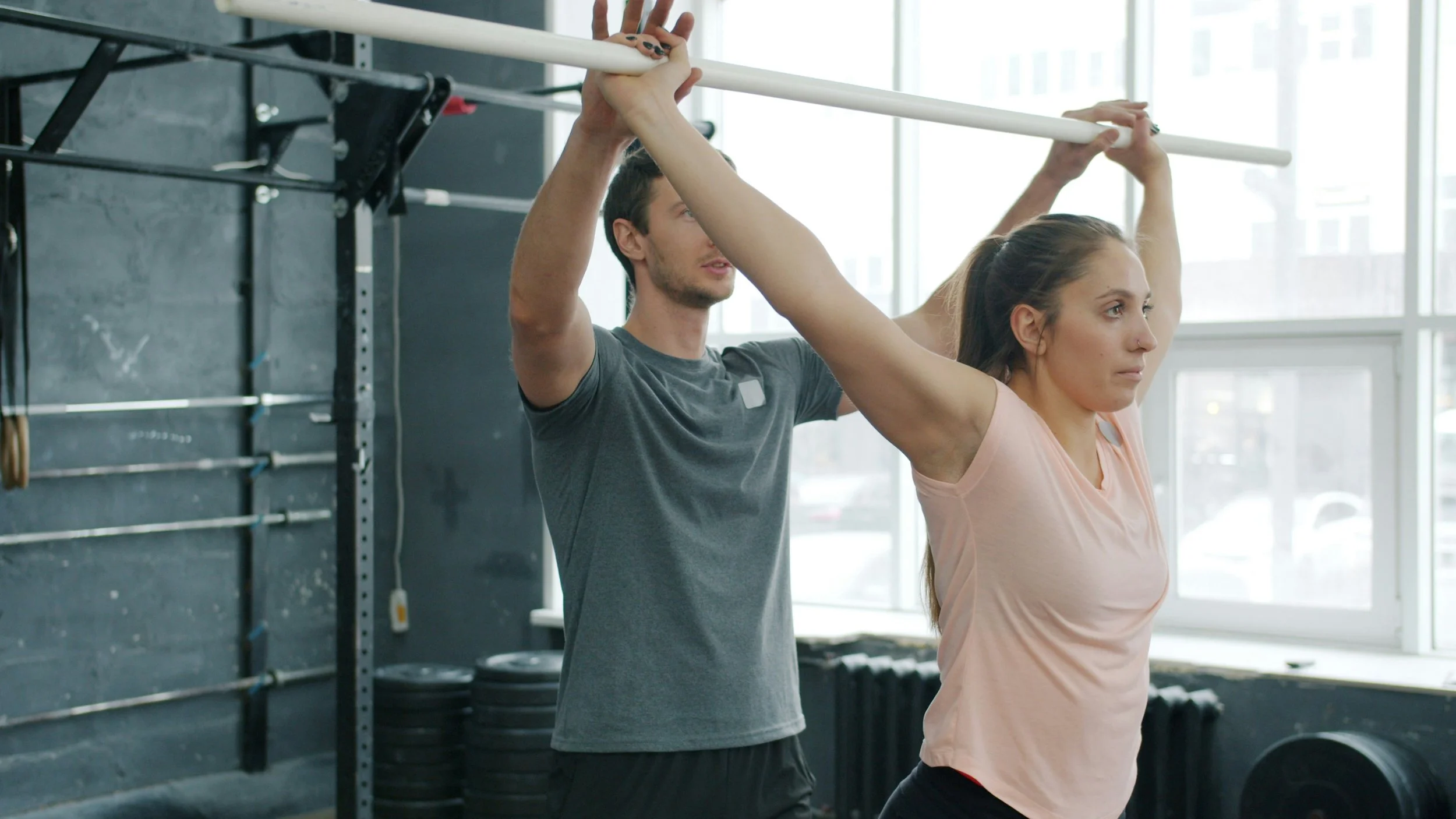
We don’t change the fundamental movement. We adjust the load, the speed or the range of motion to meet you exactly where you are today. A squat might start as a bodyweight sit-to-stand from a chair. A deadlift might begin with picking up a light kettlebell. An overhead lift might commence using a PVC pipe.
Scaling isn't a compromise or a consolation prize. It’s the intelligent, sustainable bridge between where you are today and where you want your physical capability to be decades from now.
The Blueprint: The Pyramid of Physical Development
To build a capability that lasts, you have to build from a solid foundation. CrossFit outlines this as The Theoretical Hierarchy of Development of the Athlete, a simple pyramid where each layer feeds and supports the one above it.
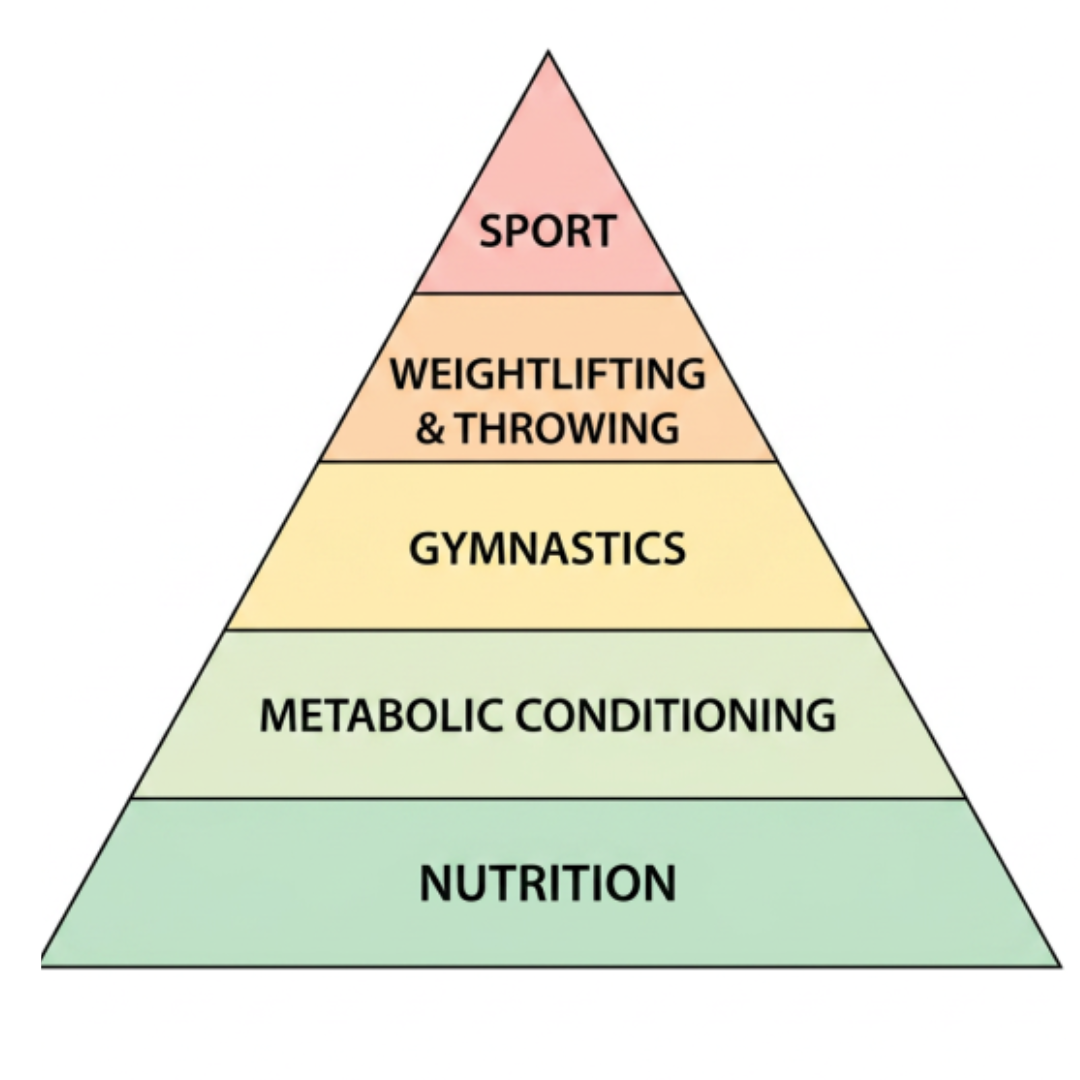
Working from the bottom up:
Nutrition: The foundational layer that fuels your health, supports cell repair, and controls systemic inflammation.
Metabolic Conditioning: Activities that build your cardiovascular engine and stamina (like walking, hiking, or swimming).
Gymnastics: Activities that support body control, balance, and spatial awareness using your own body weight.
Weightlifting: The practice of controlling external objects (groceries, luggage, weights) safely and efficiently.
Sport: The practice of applying your physical capability to real-world adventures, such as hiking, gardening, traveling, playing with grandchildren, and exploring the world.
If you skip the bottom layers – if your nutrition is inflammatory, your cardiovascular engine is neglected, or you lack basic body control – trying to force high-level activity at the top becomes unsafe. But when you build from the foundation up, your physical retirement account grows with compound interest.
The Question to Walk With
This week, as you go about your daily routine, carry this simple reflection with you:
Looking at the layers of the Pyramid of Physical Development (nutrition, metabolic conditioning, body control, weightlifting and sport). Which layer feels the most solid in your life right now? Which one would benefit from a little extra care and practice this week?