
Wellness is the Baseline

I was sitting on a folding chair in a CrossFit gym I'd never been in before.
The space was big and cavernous and hummed with energy. Around me, thirty other students were settling in, notebooks open, pens ready. We were all there for the same reason: to become CrossFit trainers.
When the instructor stepped up to the whiteboard and began drawing a continuum – a curved line mapping the spectrum from sickness to wellness to fitness – I smiled.
I know this, I thought. I've been teaching this.
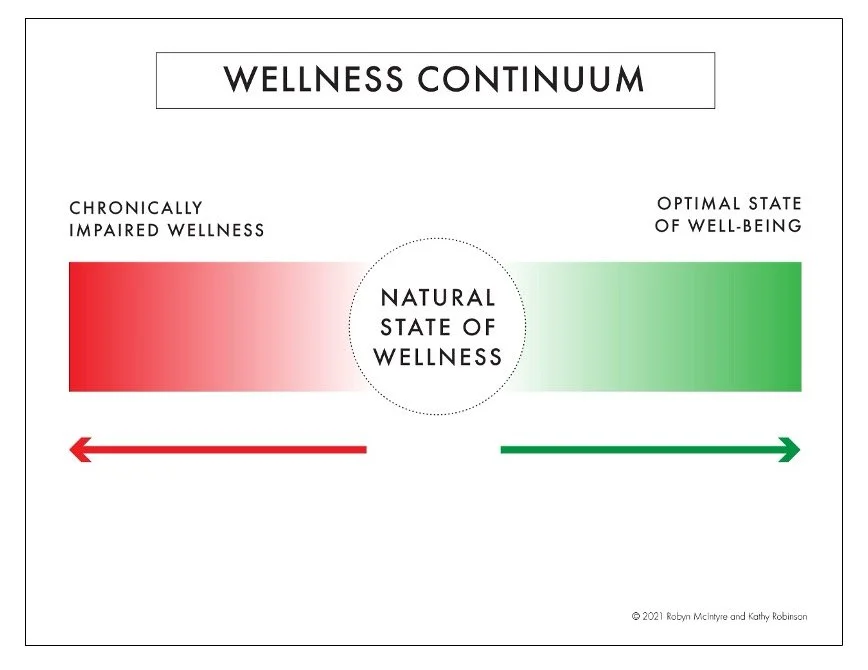
Back in 2021, my colleague Dr. Robyn McIntyre and I had created our own Wellness Continuum for a joint presentation we were giving. We'd mapped the full breadth of health, ranging from chronic illness to optimal well-being. I'd been using it ever since in wellness talks, with coaching clients and in my writing.
I was proud of it. And sitting in that folding chair, I assumed I was about to have my thinking confirmed. I was wrong.
Not dramatically wrong. Not embarrassingly wrong. But wrong in the way that matters most – the kind of wrong that quietly expands everything you thought you understood.
As the instructor explained the CrossFit version of the continuum, something shifted.
My continuum had framed optimal wellness as an aspirational direction, a destination to move toward. The further right you traveled on the spectrum, the better. Wellness was the goal and optimal wellness was the motivation.
But CrossFit's continuum reframed this.
In the CrossFit model, wellness isn't the destination. It's the baseline. It’s merely the absence of disease.
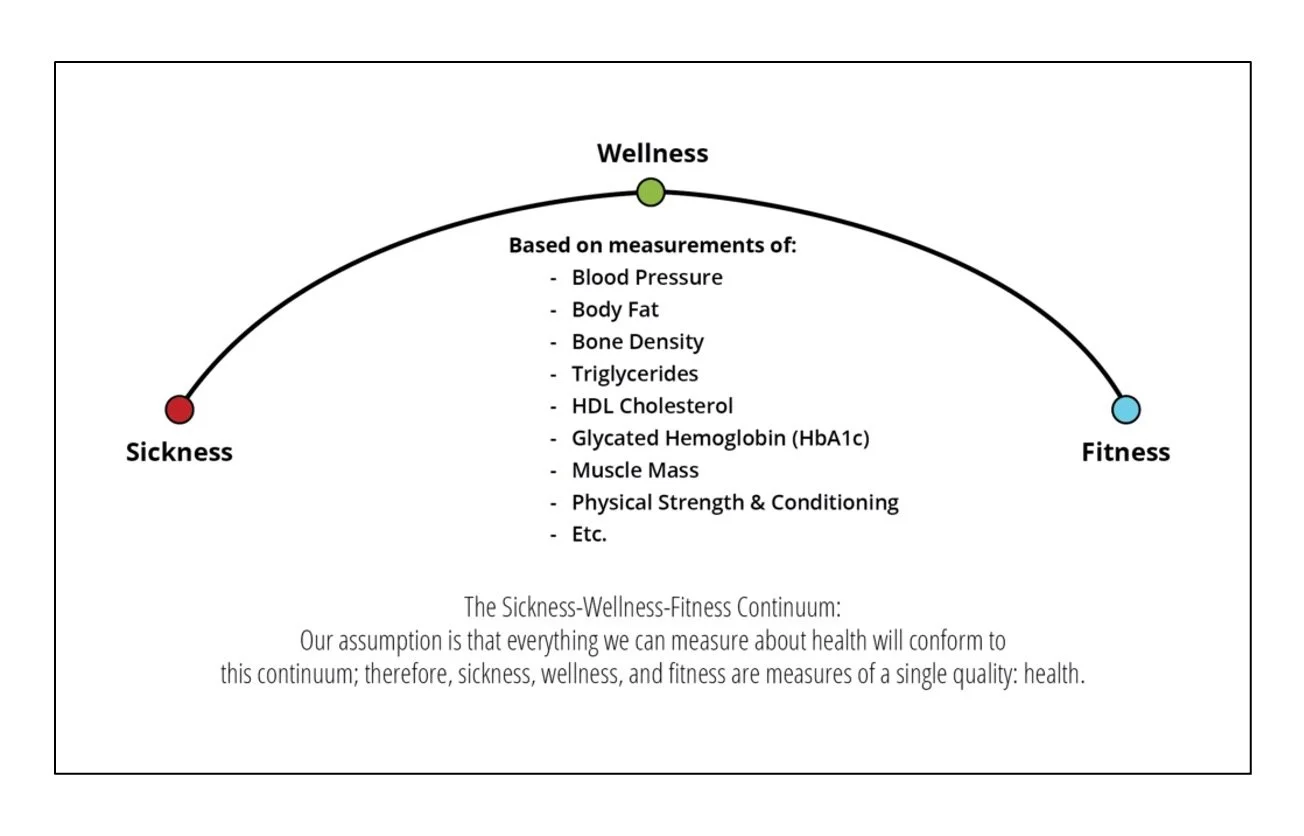
Fitness – true fitness – is something else entirely. It's a state of super-health that sits beyond wellness. A physiological buffer. A margin of safety that wellness, by itself, can never provide.
I sat with that for a moment. And then I understood what I'd been getting wrong.
By framing optimal wellness as the aspiration, I'd been inadvertently telling my clients, my readers and my audiences to aim for neutral. To celebrate the absence of disease as the finish line. To stop climbing once they reached the middle of the road.
In that moment, a new challenge presented itself to share the importance of aiming for fitness, not wellness.
That night, I went home and pulled up my bloodwork and fitness metrics.
I mapped them against the CrossFit continuum, curious to see if I was considered well or fit.
What I found brought me genuine relief. In most areas, I was sitting in the fitness zone. In a few, I was in the leeway between wellness and fitness – close, but not quite there.
I felt proud of that, not only because I knew what it had taken to get there, but that I had bucked the agist tropes of decline.
The Myth of the Steady State
When we enter midlife, we're subtly conditioned to accept a baseline of neutrality.
We're taught that if our blood pressure is normal, our bone density isn't a crisis yet and nothing actively hurts, we're doing great. As a result, wellness is viewed as a safe harbor, a place to arrive and rest.
But aging is a constant, downward pressure.
If your physical capability is sitting right at neutral, you have zero margin for error. You're one patch of ice, one severe bout of illness or just a few years of natural muscle loss away from sliding backward into dependency.
The steady state isn't safe. It just feels that way.
And here's what makes it more complicated: the clinical reference ranges we use to define "normal" are based on averages of general populations. As our collective health declines – with rising rates of obesity, sedentary lifestyles and chronic disease – what's considered normal shifts to accommodate that decline.
If you're aiming for normal, you're aiming for a baseline that is slowly sinking. That's not a safe harbor. That's a slow drift toward the sickness zone, one that's almost impossible to see until you're already in it.
A Different View: Surviving vs. Thriving
The CrossFit Sickness-Wellness-Fitness Continuum offers a fundamentally different way to see health.
It frames health as a single, measurable quality along a spectrum:
Sickness is pathology: The presence of disease, dysfunction or significant physical limitation
Wellness is the neutral absence of disease: Normal lab results, nothing actively wrong
Fitness is a state of super-health: Physical capability, resilience and vitality that sits well above the average
Under this framework, two definitions become essential:
Fitness is your work capacity across broad time and physical tasks – how much power, strength and endurance you can generate.
Health is your ability to sustain that fitness and power throughout your entire lifetime.
True health, then, isn't about existing in the middle of the road. It's about continually expanding your physical capability so that you can maintain your independence, strength and vitality as you age.
The goal isn't wellness. The goal is fitness and the buffer it creates.
Building Your Buffer
When you actively train for the fitness zone, you're not just getting stronger or healthier in the conventional sense. You're building physiological headroom.
Think of it as a physical retirement account.
By moving your health markers and physical capabilities into the optimal range, you create a massive safeguard. Your health becomes so elevated from the average and sick ranges that even if you face a major biological stressor, such as a severe illness, an injury or simply the natural toll of advanced age, your decline will only drop you back into the wellness range rather than moving you directly into the chronically sick range.
That's the buffer. That's the margin of safety that wellness alone can never provide.
And just like a financial retirement account, it has to be built now. Deliberately. Consistently. Before you need it.
Because here's the truth nobody tells you: the time to build the buffer isn't when you're facing the stressor. It's before. It's today.
What the Buffer Actually Looks Like
Building your buffer requires tracking two distinct types of data. Not as a clinical pass/fail test, but as a roadmap of possibility. A living inventory of where you are and what you're building toward.
Before I share these markers, one important note: the true fitness benchmarks on this continuum are elite athletic standards. They represent the upper end of what's possible. It’s not a mandatory destination.
The magic of this model is that health is a dynamic spectrum. The closer you get to the fitness range, the larger and more resilient your buffer becomes. You don't have to hit a perfect score to win. You just have to keep moving in the right direction.
With that in mind, here are the markers worth exploring and actively monitoring:
Your Health Markers (Internal Resilience). These are the numbers in your bloodwork and biometrics that tell the story of your internal landscape. The goal isn't to be "not a crisis." The goal is to push into the optimal range and build internal headroom.
Body Fat Percentage (Target: ~12% for Female Fitness / ~20% for Wellness / Above 32% is Sickness) In the CrossFit model, body fat percentage isn't about aesthetics. It's about the ratio of lean muscle mass to body fat, and lean muscle mass is your body's physical armor as you age. The more you have, the more protected you are.
Blood Pressure (Target: 105/60 mm/Hg or below for Fitness / Under 120/80 for Wellness) Hitting the fitness target represents a highly elastic, relaxed vascular system. This means less daily wear-and-tear on your arteries and a heart that's exceptionally protected for the long haul.
Resting Heart Rate (Target: 50 bpm for Fitness / 70 bpm for Wellness) A resting heart rate of 50 bpm demonstrates a highly efficient, powerful heart muscle that doesn't have to work overtime just to keep you moving. Every beat saved is energy redirected toward vitality.
HbA1c Levels (Target: <5.7% for Fitness) This metric measures the percentage of your red blood cells that have sugar-coated hemoglobin, a powerful window into your long-term metabolic health and insulin resistance. Pushing into the optimal fitness range means more stable daily energy and a body that uses food for fuel more effectively.
Triglycerides (Target: <100 mg/dL) Keeping your triglycerides low means your body is efficiently clearing fats from your bloodstream, significantly lowering your metabolic and cardiovascular risk.
Cholesterol Balance (Targets: LDL <100 mg/dL / HDL >60 mg/dL) You're aiming for a lower count of LDL to prevent arterial plaque, paired with a robust HDL count above 60 mg/dL to actively protect your cardiovascular system.
C-Reactive Protein (Target: <1 mg/L) This high-sensitivity test measures chronic, systemic inflammation. A fitness target of less than 1 mg/L means your body isn't wasting vital energy fighting a quiet, internal fire.
Your Performance Markers (Functional Capacity). This is where the rubber meets the road. In the gym, these are tracked through weights and times. But on the trail and in your daily life, your functional strength and endurance correlate directly with how long you will retain your freedom. These aren’t gym metrics. They’re life metrics:
Maximal Strength: In the gym, this is your capacity to deadlift or squat. In your life, this is your ability to independently hoist a 40-pound bag of birdseed or garden mulch, lift your own carry-on luggage into the overhead bin, or carry a heavy basket of laundry up a flight of stairs without a second thought. This is the strength that keeps you independent. And it has to be built, deliberately, progressively, consistently, before you need it.
Endurance & Capacity: In the gym, this is a rowing split or a running time. In your life, this is your cardiovascular engine. It’s the stamina required to maintain a sprawling garden, walk a steep hill on your favorite trail, or spend an entire afternoon on your feet exploring a new city with ease.
Body Control: In the gym, this means pull-ups and push-ups. In your life, this is the vital capacity to move your own body weight through three-dimensional space. It’s the core stability needed to prune a low shrub, the balance required to navigate uneven terrain, and the crucial strength needed to get up off the living room floor easily without needing to push off a piece of furniture.
That last one matters more than almost anything else. Because the ability to get up off the floor independently is one of the strongest predictors of longevity we have.
If your performance markers are high, you’re operating from a position of true physical sovereignty. You’ve built a buffer that actively protects your future.
Redefining Your Baseline
The Sickness-Wellness-Fitness Continuum asks something of us that most wellness conversations never do. It asks us to stop being satisfied with neutral.
Not because neutral is wrong, but because neutral leaves you completely exposed. One illness, one injury, one winter of inactivity away from a decline you didn't see coming and weren't prepared for.
The shift this continuum invites is profound: from a reactive, symptom-treating mindset to a proactive, performance-optimizing one.
Each daily choice you make, from exercising with a little more intensity to prioritizing high-quality nutrition and deep recovery, is a vote to move yourself further toward fitness. It's a commitment to distance yourself from the dangers of the sickness zone and enjoy the benefits of a super-wellness state of being.
Unlearning the steady state myth doesn't happen overnight. It requires not accepting what society considers "fine for your age" and welcoming what’s truly possible for your future.
I know this because I've lived it. The metrics I mapped against that continuum the night I came home from the CrossFit classroom didn't happen by accident. They happened because of years of deliberate, consistent choices, especially the choices that felt hard in the moment but feel like freedom now.
That's what the buffer feels like from the inside. And it's available to you.
What's on the Horizon
Over the next two articles, we're going to get practical.
We'll dig into functional movement to explore what it actually means to train for the life you want at 90, not the body you had at 40. And we'll explore nutrition, not as restriction, but as the clean fuel that powers everything else.
But it all starts here. With the reframe. With the question of what you're actually building toward and whether wellness alone is enough to get you there.
It isn't. But fitness is. And you're closer than you think.
A Question to Walk With
This week, I invite you to pull out your most recent bloodwork and look at your numbers – not with judgment, but with curiosity.
Where are you on the continuum? Not just in the clinical sense, but in the felt sense. Does your body feel like it's operating from a position of buffer and resilience? Or does it feel like it's sitting right at neutral, with no margin for error?
And then carry this question with you on your next walk: If wellness is the baseline, what am I doing today to build a true buffer of fitness for my future self?
You don't need to answer it all at once. The buffer builds one choice at a time. Just start walking toward it.