
Between Menopause and Gentle Yoga
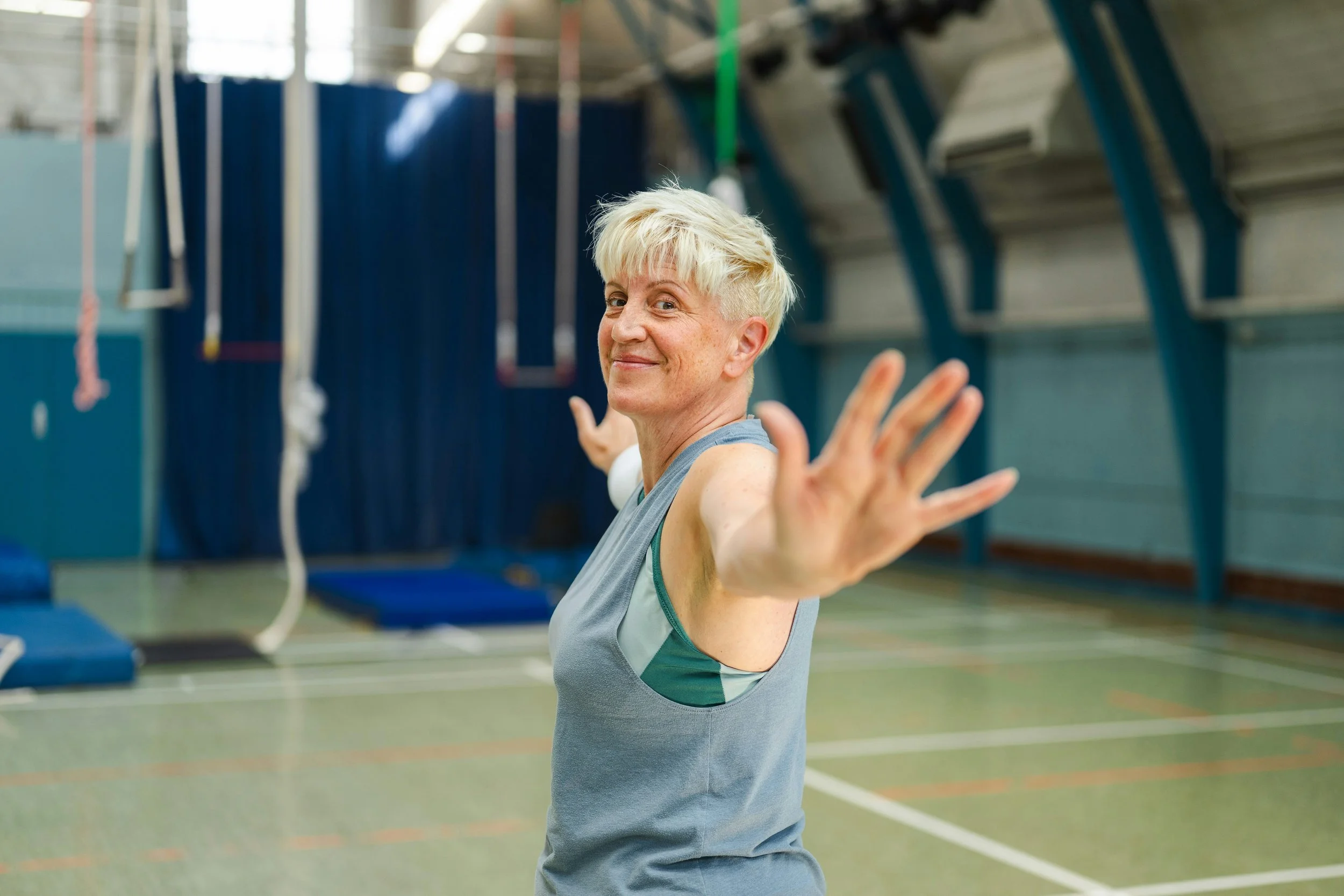
I became a certified trainer at 62. It was a process that included classroom instruction, hands-on training and a timed online exam. It had been decades since I studied for a test.
It wasn’t because I wanted to work in a gym. I did it because I was taking my own fitness seriously and I wanted to keep getting stronger. I was determined to keep upping my game, but I couldn't find a program to support my intention.
Isn’t that odd? There’s no shortage of fitness advice. I have shelves of fitness books, listen to wellness podcasts and stay up-to-date on the trends. Even so, I didn’t see myself reflected in any of the latest advice.
At 62, I was already active, but knew I needed to make some changes if I wanted to keep building strength and capability for the next thirty years. What did I need to stop doing and what needed to be added to preserve my joints and overall wellness for decades to come? It seemed like every resource I picked up was written for someone else.
The Two Shelves
Walk into any bookstore and the fitness section has essentially two shelves for people my age.
The first is written for those in the thick of hormonal and midlife change. These books are mostly aimed at people transitioning from their forties to their fifties, organized around managing symptoms and stabilizing a life in transition.
The second shelf is written for older adults, and its central promise is gentle movement designed to keep you safe as you age, an important and underserved topic.
But neither shelf was answering my question: How do I get stronger from here?
There's a third shelf that’s empty. It's for those who’ve moved past the hormonal years and the midlife reckoning and still want to keep lifting, carrying and climbing. It’s for those searching for advice on how a body at 57 or 65 or 73 actually builds strength and what to do when the training that worked at 45 no longer feels like the right approach.
Somewhere Between Not Adjusting and Not Returning
In the absence of guidance and role models, I’ve watched people my age fall into two groups.
The first keeps their workout intensity where it’s been for years and ends up injured, chalking up the setback to getting older. The second stopped at some point and hasn’t gone back, not wanting to risk embarrassment or failure.
But there’s a third way that sits between the two groups, and it’s what I was searching for: keep what still serves, scale what doesn’t and add what’s missing.
Sounds simple. But how do you do that in a way that’s personalized and specific to you?
No One Can Hand You a Plan
Earlier this year, my frustration turned into something more useful.
Even if the perfect guidance existed, I realized it probably wouldn’t fit. There are too many variables as we get older. Beyond our physical abilities and goals, there may be medications, surgeries, chronic conditions or degenerative symptoms to take into consideration. Two people the same age with the same ambition can need different things and no approach can address all of it at once.
The programs tend to land in one of two places. They’re either too general to act on (“eat the rainbow,” “women should lift heavy”) or they’re aimed at a specific condition (Type 2 diabetes, lower back pain). While most are well-researched and well-intentioned, I usually take one or two good ideas from each and then I’m back where I started, looking for a holistic approach.
That's the point, though. The author’s program fits them. It was built for their challenges, body, schedule, injuries and goals. Some of it transfers to me and some of it doesn't. The only way to learn is to try it and notice whether it makes sense to incorporate it into my wellness routines.
Which is how I approach my wellness coaching now. When I work with a client, I don't hand over a plan. We talk, and through that conversation we determine what would make the biggest impact to their wellness. Along the way, I pay attention to their energy level to distinguish between the changes they feel they should make and the one they’re energized to make.
Only then can we design a plan they can try – one that becomes a living practice rather than a static document. We adjust as we go, and the client learns to trust their own body and knowing along the way. Self-reliance is the most important muscle I can help someone build.
Which leaves a practical question for anyone trying to do this alone. In the absence of preformulated plan, where do you actually begin?
Begin with What You’re Unwilling to Lose
The answer isn't a plan. It's a list.
Before you select a program, determine a schedule or hire a trainer, write down what you’re unwilling to lose. Instead of focusing on what you'd like to improve, think about what you refuse to give up.
Be specific, because vagueness stops progress. “Healthy aging” isn't a goal, it's a wish. “Get back in shape” isn't a target, it’s an abstraction. Neither one tells you what to do on a Tuesday.
Dig deep and name it. Perhaps it’s living in your own home for the rest of your life. Maybe it’s gardening all afternoon and having the energy to enjoy dinner with your partner. How about carrying your luggage throughout the airports on your vacation? Perhaps having the flexibility and balance to play with your grandchildren or hiking your favorite trail with confidence.
Pick the one thing that truly speaks to you, that you want more than anything else. Then work backward and ask: What does that require of me today?
If it's getting off the floor unaided, you need leg strength, hip mobility, balance and the power to coordinate all three. This means incorporating some form of squats, lunges, push-ups and balancing exercises. If it's carrying your own bags when you travel, you need grip, core and structural strength, which means some form of deadlifts and farmer’s carries. If it's hiking your favorite trails, a combination of cardio and balance will support you.
This is how I found my way to CrossFit and the Level One training program. I started with the one thing I refused to lose: my independence. I want to care for myself and my home for the rest of my life. From there, I worked backward into the mindset, training, nutrition and recovery required to protect it. I'm still working backward today. That's the practice.
How to Build Your List (And Your Protocol)
Give it a try. Spend some time turning what you’re unwilling to lose into a complete wellness protocol.
Write your “Refuse to Lose” list. Write down three to five specific, non-negotiable parts of your life that you refuse to surrender. Focus on real-world moments, especially the things that define your independence and joy.
Circle the one that matters most. Look at your list and circle the single item that hits closest to home. This is your anchor. Everything else is secondary.
Reverse-engineer your wellness protocol. Take your circled anchor and work backward across the four pillars that actually sustain it:
Mindset (Mind): What mental habits protect this goal? Maybe it’s shifting from “working out to burn calories” to “training for capability,” or committing to consistency over intensity when motivation dips.
Training (Body): What physical demands does this goal require? Break it down into basic human mechanics and focus on pushing, pulling, squatting, carrying or balancing.
Nutrition (Body): How do you need to fuel and hydrate to support that work? Focus on what gives you sustained energy, builds muscle and keeps inflammation low so your body can actually do the job.
Recovery (Mind, Body, and Spirit): What restores you so you can show up again tomorrow? This means protecting your sleep, managing stress, taking rest days seriously and making space for the relationships and quiet, creative moments that keep your spirit fed.
Amend your current routine. Look at how you spend your time and energy across those four pillars. Where’s there a gap between what you say you’re unwilling to lose and how you are actually living? Pick one small adjustment in a single pillar and start there.
You don’t need a complicated overhaul to begin. You just need to name what matters most and build a daily practice worthy of keeping it.
The Third Shelf
I got my training certification because I didn’t see myself in the fitness and wellness world.
I wanted to keep lifting and achieving my CrossFit goals in my sixties and beyond, including unassisted pull-ups, rope climbs and wall walks. I wanted to keep running, get out on the trails and keep improving on my kickboxing skills. I wanted to fine tune my nutrition, learn more about recovery and keep my mindset positive and enthusiastic.
What I found wasn't a perfect program. It was the understanding that the plan I needed couldn't be replicated from anyone else. And neither can yours. It has to come from your own list of what you refuse to lose, practiced consistently, adjusted as your body and your life keep changing.
Which means the third shelf isn't actually empty. It's purposely unstocked so each of us can fill it ourselves, one person at a time. Turns out, this isn’t a problem to solve. It’s the point of the journey.
A wellness plan isn't a document you finish. It's a practice you keep.
A Question to Walk With
As you go about your week, carry these questions with you:
What are you unwilling to lose? What’s the one adjustment that would move your daily life closer to protecting it?