
Who Am I Now? The Quiet Work of Creating Your Second Chapter Identity
To build a successful life, you need to develop an identity that’s robust, reliable and suited to manifest that success. But what happens to that identity when you make a life change?
I had this experience when I brought my 33-year corporate career to a close. Even though I never felt that my identity was closely tied to my profession and a created a detailed plan to start Athena Wellness when I left corporate life, I had to face the quiet work of answering this question: “Who am I now?”
This moment of searching isn’t a problem to be solved – it’s a powerful invitation. Identity transformation is necessary to adapt to new circumstances, such as a major career change, an empty nest, or a shift in your partnership. And when you approach it mindfully, it empowers you to design your next chapter with clarity and confidence.
Personal identity is defined as a unique set of characteristics, qualities and beliefs that you use to define yourself. Components of identity include things like self-concept, personality traits, values, beliefs, memories, experiences, social roles and group memberships.
Personal identity isn’t static. It’s a dynamic, evolving process that’s continuously shaped. It links who you were in the past, who you are today, and who you dream of becoming. You can think of it as a framework that influences your beliefs and behavior.
As a midlife professional, the demands of your successful career contributed to your self-concept. The identity you built had to be robust enough to handle the pressure, deadlines and productivity. As a result, you developed a set of autonomic behavioral patterns – automatic habits that ensured success without conscious effort.
This creates quite a paradox when you’re ready for your next chapter. The identity and habits that made you successful for decades now become an unintentional constraint on your future.
If you don’t intentionally examine and adapt your self-concept as you prepare for your next life phase, your old patterns will inevitably emerge and perhaps lead you down a familiar path rather than your desired one.
Why does this happen? We’re wired for behavioral congruence. Our actions naturally try to align with the person we believe we are. If you’re holding onto the identity of the person you were, it will be difficult to navigate the path of the future self you’d like to become.
This is why the quiet work is essential. It’s the moment we choose to examine our behavioral patterns and align with the future self we desire. It’s about choosing which patterns to keep, develop or release.
The first step in creating a new identity isn't outward action – it's stillness. We can’t move forward cleanly if we don't first acknowledge and make peace with the person we were.
Stillness isn’t passive. It’s an active choice to step away from the noise and listen to what the transition is asking of us. And often, what surfaces in that quiet space is the need to acknowledge a profound sense of loss.
This brings us to grief. For successful professionals who are in transition or contemplating next steps, there is often a deep sense of loss that we aren't prepared for or equipped to handle.
But we can learn to process the emotion that’s part of completing a major life chapter. This comes from honoring the journey that brought you to this point, while also acknowledging what will never be as your life scenario shifts.
The bottom line is that grief is not a failure – it’s a vital act of completion. Be aware of it, process what you can, and if it’s overwhelming, reach out and talk to someone who can give you guidance.
By acknowledging your grief and honoring your past, you’ll gain the clarity and space needed to design the future you most desire.
Now to the quiet work. The process of creating a new identity starts with a simple realization: your identity isn’t some abstract concept – it’s comprised of a few key drivers that influence the direction of your everyday life.
Here’s a simple contemplation exercise that moves you from unconscious habits to conscious life design. You just need a piece of paper and a pen. We’re going to create a simple two-column list relating to your current self and your future self. By seeing the two versions of yourself side-by-side, you’ll gain the insight needed to create behavioral congruence.
Draw a line down the middle of the page and label the left-hand column “My Current Identity Drivers” and the right-hand column “My Future Identity Drivers.”
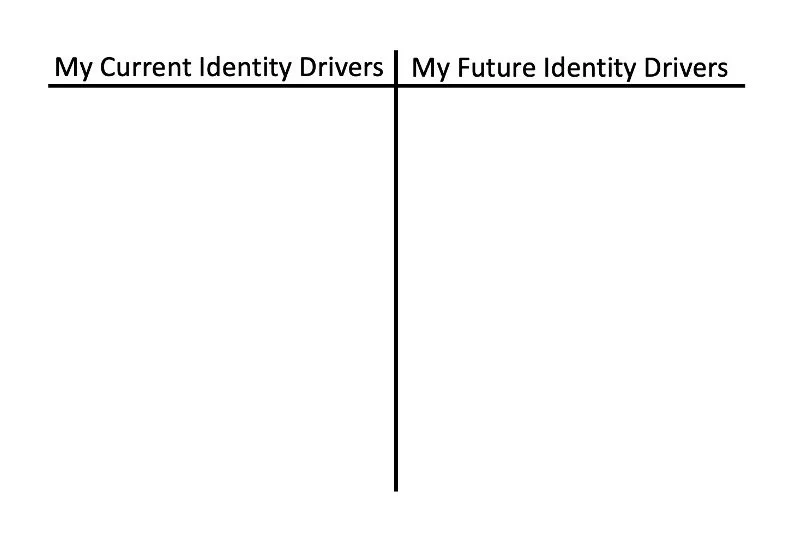
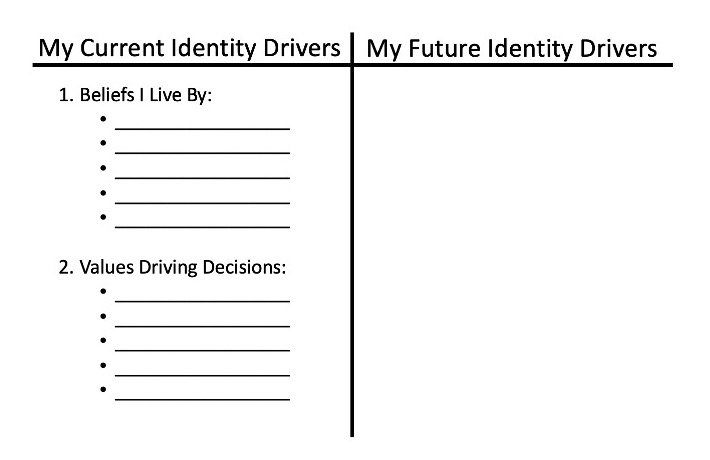
We’ll start with the Current Identity Drivers. This column is your honest examination of the person who drove your past success. These are the patterns that are currently running on auto-pilot. They include your beliefs and values. Specifically:
The Beliefs You Live By: List the top deep-seated beliefs about work or worth that currently run your day. For example, when I was in corporate, I would include things like “my value equals my productivity” or “hard work equals success” or my favorite, “consider it done.”
The Values That Drive Your Decisions: List the values that you consistently prioritize. Using myself as an example again, my corporate self would say productivity, discipline and dependability.
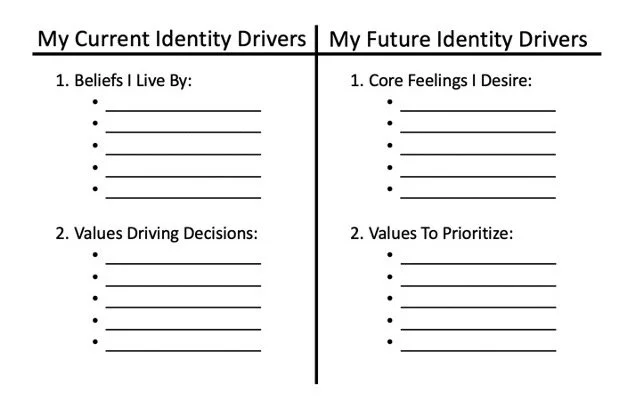
Now give some thought to your future identity drivers. This column will help you intentionally create a framework of the person you want to become. This is where we focus on your desired internal state. They include your core feelings and prioritized values. Specifically:
The Core Feelings You Want: List how you’d like to feel in your next chapter. As I was planning my transition to entrepreneurial life, my list included feelings such as creative, vital in body, mind and spirit, connected in relationship, abundant and present.
The Values You Want to Prioritize: Now list the values that would align with those feelings. For me, it was growth mindset, self-care, collaboration, gratitude and mindfulness.
Here’s the critical last step. As you look over your future identity list, select one feeling or value you want to develop the most. Then choose a small, low-stakes action that will demonstrate your commitment to your future self each day.
As an example, in my last year of corporate, I had a five minute visualization I did each morning of what life would be like once I began working full time at Athena Wellness. This visualization that only took 5 minutes began to create my new identity as a creative, vital, connected, abundant and present entrepreneur.
By performing this small, consistent action, you’re showing yourself that you’re the type of person who can become your future self. And as a five-year entrepreneur who is still excited about her work, I can definitely say it works!
We began this article by actively contemplating the sometimes unsettling question, "Who am I now?" As you can see, the quiet work is the answer.
By exploring your current and future identity drivers and honoring the grief necessary for completion, you've done more than plan — you've started the design process of your next life chapter.
Your small daily proof is the intentional, low-stakes action that builds behavioral congruence, helping you replace the old automatic patterns with ones that support a life that is truly your own.
The ultimate benefit of the quiet work is the clarity and confidence that emerges along with your new self, ensuring you never feel untethered as you navigate this life change.
Journal Reflections: What emotions surface when you think of honoring and releasing the successful self you were? What’s the greatest internal conflict between your current dominant belief and your desired future feeling? If your future self directed your day, what single small daily proof would they instinctively choose to live by?
P.S. Ready to move from that unsettling "Who Am I Now?" phase to a confident life design? If so, I've created a special gift just for you! It’s a guide called 5 Questions to Explore a Soulful Second Chapter. It contains the type of reflective work that gave me the courage to make my midlife transition. You can download it for free at athenawellness.com/reimagine.
Links:
YouTube: The Athena Wellness Channel
Work with Kathy: Coaching Opportunities
Email Kathy: hello@athenawellness.com